SUBSCRIBERS’ HOME / UPDATES / FEATURES / NEW TO HOME EDUCATION? / PRACTICAL MATTERS / WEBSITES / RESOURCES / SEN / PLACES TO VISIT / SOCIAL LIFE / USEFUL INFORMATION / TUITION AND SERVICES / FROM YOU TO US
Rest
After thirteen plus years of home educating, the question I most frequently pose to myself is: could I have done better? I would like to have the time to assess this daily but, barring a quick scribble in a diary to record the basic events of the day, my real thoughts and feelings usually pass un-noted. But the spring is a lovely time for reassessment and looking from the perspective of someone whose older children are now completing their  education outside of home but the younger ones are just embarking on abc, I know I am blessed enough to have a second chance to do things right, or at least perhaps a little better.
Recent reading has brought me to the conclusion that some of the more important gifts that we can give our children involve emotional education. Learning to recognise, name and sit with emotions as opposed to dumbing them down via reading, screen time or chocolate is so much healthier but obviously not a natural response for many parents. How much easier it is to distract a crying child via Cbeebies or a Freddo than to take the time, never mind energy, to sit with them, hold them, appreciate their sadness, disappointment or frustration and allow them to feel it, express it, work through it and emerge on the other side loved and refreshed and knowing more about themselves. As hard as it sounds, can you imagine the leap forward for world if the members of next generation did not numb themselves with food, TV, computer games and wine, and understood how to work through negative emotions to find the love beneath? What if they knew how to ask for a quiet moment to allow anger to pass, that they needed to take some space to process disappointment before responding to other demands, that their personal frustrations are best worked through with a friend on a long walk in nature? That kind of self knowledge is invaluable, life changing, and yes, potentially world changing.
The world only grows more demanding and stressful as we grow through childhood to adolescence. Diversions become tasks and entertainment a social responsibility that is addictive and for young people it can become impossible to control. The effect of this is huge and long term, possibly setting our children up for a whole lifetime of non-stop. Explains Alex Soojung-Kim Pang, a researcher at the Institute for the Future, a Silicon Valley think tank: ‘What’s happened with mobile devices is a nice example of how labour-saving technology can end up taking us in a very different direction from the original proposition. The digital dream was that it would allow us to break our eight hour work day into several chunks. If, in the middle of the day, you needed to go off and do childcare, you could come back to the work later. That isn’t happening. Instead, those ‘chunks’ of work have been ground down to a fine powder that settles over our entire waking hours. The ability to always be accessible has morphed into an imperative to always be ‘on’. We are like televisions that are never turned off.’
Teaching our young ones at home gives us the perfect opportunity to teach them about rest. It will become a tougher task to help them to learn the value of controlling and limiting screen time but if before that they have learned to recognise and respond positively to their personal cues which signal a need for rest, then our task will be considerably easier. According to the book, Rest by the aforementioned Alex Soojung-Kim Pang rest is very different from sleep. ‘We live in a culture that downgrades the importance of rest, and confuses it with how much sleep we get.’ Pang advocates something he calls active rest, re-energising through the practice of a hobby. ‘For the purpose of psychological restoration, it is often more beneficial for us to do things that are effortlessly engaging and diverting, things that still offer us some measure of challenge…Hobbies capture our attention and our mental energies.’

Where better than in the safety and natural learning environment of home to develop a hobby habit? Rather than feel the pressure to rush our little darlings from one class to another in the mode of school educated children who seem to get very little down-time even out of school hours, how about we add some much-needed weight to the value of a home based hobby or two? Art, writing, reading are the obvious choices, but lego can be a life-time love (possibly with a little upgrade or two via meccano to motorbike restoration or clock making), as can electronics that began with snap circuits or simple battery experiments.
Some parents that I have spoken to struggle with feelings of inadequacy in the area of interests and hobbies as they themselves were not given time or encouragement in pursuing such interests of their own. ‘I had horse riding lessons’ explains Sonia ‘But as my parents couldn’t afford to buy or keep a horse for me then it really didn’t go much further than once a week at the local riding school. They felt out of their depth with an interest that they had no experience of and seemed relieved when I dropped it in favour of going shopping with my teenage girlfriends. Now I wish I had persevered so that instead looking for relaxation and refreshment as a typical over-consumer I would have a go-to for when I need to really re-charge and would be more equipped to help my children find the same for themselves.’
‘My father took me bird watching but I always felt that this was his ‘thing’ and that I was taken along rather reluctantly in order to give my mother some space. He expected me to get as much out of it as he did and while I enjoyed it to an extent, I found it hard to stay still for so many hours and would frequently get cold and tired and hungry which would force him to cut the trip short. Looking back from my own experiences as a parent, I can see that he expected a lot of me considering my age at the time, but I can also see that observing his absorption in something outside of his work and home life was a healthy influence on me. I have tried to maintain an interest or two for myself to pursue when I have the chance although carrying mobile devices does mean that I don’t really ever switch off. This means it is hard to find the time and energy to devote to helping our children find a hobby of their own and it is definitely something I need to consider more carefully from now on,’ Andrew, father of Mia and James related.
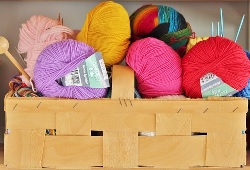
If you are reading this, shaking your head in bewilderment and have no clue where to begin I would recommend starting with air dry clay. Anyone who can lay some oil cloth on the floor and find a sports capped bottle of water can manage a session of tactile, relaxing, no pressure play with a lump of clay (try buying a small block at The Works or online) that not only washes well off clothes but requires no kiln and no agenda. Small projects to experiment with if you require a goal include coil pots, leaf imprint dishes, mice, thumb pots, snails, blob-men. Use some cookie cutters and a skewer to create little hanging gifts for grandma. Get messy, get busy, chat and squelch your fingers into a whole world of potential. Chalk pastels have the same feeling (invest in some pastel paper if you can: it is lovely), as do knitting yarn (french knitting, simple crochet and circular knitting needles are all easy for beginners), packets of seeds and a bag of compost, a flower press and some old frames from charity shops, a few squeezy tubes of paint and some thick paper.
Read some haiku and try making a notebook or buying a gorgeous heavy-papered hard backed notebook and a delicious new pencil. Take a walk in nature and gather some thoughts. Haiku away. Invest in Storybox cards and play until you love the story you have created. Write it down, illustrate it in whatever way comes to mind. Cut and stick from some old magazines and create fictional characters from the collages, write a ‘cup’ – a short description of who and what and why and where.
The best free-entry into real creative play or life-time hobbies however, has to be nature. A non prescriptive walk in nature is the rocket fuel for a million hobbies that can be the medicine of a lifetime. Teach your children to love, value and make time for the natural world and they will have the tools to care for themselves and their need for restorative, energy-creating down time. Make a walk part of your daily self-care too, especially if you find yourself feeling drained and hobby-less. Provide the best model you can to enable your children to prepare for a demanding world. As home educators we are under less and yet somehow more pressure. Read and re-read this article to give yourself permission to make this part of your daily practice and remember the value of teaching by example the importance of real rest.
© Melanie Crocker-Hulse