SUBSCRIBERS’ HOME / FEATURES / NEW TO HOME EDUCATION? / PRACTICAL MATTERS / WEBSITES / RESOURCES / SEN / PLACES TO VISIT / SOCIAL LIFE / USEFUL INFORMATION / TUITION AND SERVICES / FROM YOU TO US
Play in early years education
As formalised learning begins ever earlier, are we rushing our children into experiences for which they are not ready? Early years education is now freely available for children aged two and three. Competition for the most highly-rated settings is intense and many parents are anxious to start their children off as early as possible in order to ensure that they are ‘school ready’.
Perhaps the most significant and far-reaching consequence of placing such young children in an educational setting is the effect on their capacity to develop through play.
Play in early years settings
Early years education emphasises the value of play in children’s development but there are two issues. First, the controlled, artificial environment in which the children spend time playing with specially-designed equipment may seem appealing, but it may limit their ability to develop their imagination and their faculties for exploration and discovery.
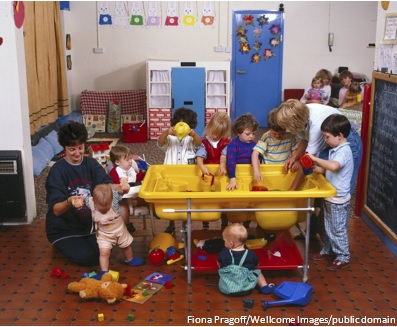
Organising and managing a group of young children makes it necessary for most of the activities to be led and directed by adults; their priorities are not the same as those of their young charges. Many of the activities are designed to develop the social skills and compliant behaviours which will be needed in the reception class, and there is a danger that these developmentally crucial years may be spent preparing for the next stage in education instead of being experienced for themselves in the here and now. Too much emphasis on preparation for the future tends to detract from the needs of the present, and much might be lost as a result.
Second, there is constant pressure on settings to ‘deliver’ the early years curriculum in order to ensure that children achieve the required outcomes. The DfE states that ‘Ofsted is the arbiter of quality in the early years’ and in 2014 the Government announced plans (now on hold for the time being) to impose baseline assessments on schools when children enter their reception year. These tests were intended to be the starting-point for measuring the progress made by children in the course of their primary education, thereby putting increased pressure both on early years settings and on schools. As it is at the moment, a preoccupation with outcomes may cause problems when young children vary so greatly in their rates of development. Further pressure in the shape of Ofsted is bound to cause concern amongst staff about the young participants who make slower progress than their peers.
Play at home
It is inevitable that the concept of play at school or nursery settings is worlds away from the the child’s experience of play at home. Young children need time and opportunity to discover the world and make sense of it in their own way, inspired and helped by adults to whom the child is attached. Home is a safe, secure base from which children can reach out through play and begin the adventure of finding out about the world. This supportive connection should not be ruptured until the child is ready, and readiness will vary greatly between individual children. Home education offers an opportunity for parents to give young children time to develop and explore the world at their own pace, enjoying each new experience to the full and pursuing it wherever it might lead.
Researchers and psychologists who have studied play agree that it is vital for child development, not only for the child’s imagination and creativity but also for the development of social, emotional and intellectual skills.
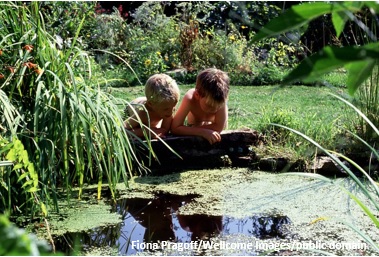
In an article in the American Journal of Play (Summer 2008) David Elkind observes that children do not think in adult concepts and categories. They approach the world from many different perspectives as if through the eyes of an artist, a naturalist, a writer or a scientist. He says: ‘When we offer our children opportunities to explore this new and exciting world in their own time and at their own pace, we open them up to powerful learning experiences they could not encounter in any other way. Why intrude on a time when children are instinctively learning with such joy and enthusiasm?’ He questions why young children should be rushed into adult-led learning experiences when they have their own priorities which are far more significant to them. The aim should be to support and encourage the child to explore, question, wonder, imagine and be curious about the world.

Research findings
A major five-year study led by Dr Kathy Sylva (EPPE 3-11, 2004) investigated the impact of pre-school education and home learning environments on the educational outcomes of 3,000 children. The overall finding which made the news at the time was that high quality pre-school provision had positive effects on children’s intellectual, social and behavioural development. Taken at face value this might suggest that children who are educated at home during the early years are missing out, but a closer look shows that the reverse is true. The researchers state: ‘The quality of the early years home learning environment also remains a strong predictor of better outcomes both during pre-school and throughout primary education and a stronger influence than family socio-economic status or income.’ The data presented throughout the report shows that the impact of different aspects of the home learning environment on children’s future achievements is highly significant. The research categorises the home learning environment into four areas. These areas are: parent-child use of home computing; parent-child ‘enrichment’ outings and activities; 1:1 parent-child structured educational activities and child’s opportunities for expressive and make-believe play.
Another research report produced for the DfE by NatCen Social Research (Ruth Maisey and others, March 2013) followed up an early education pilot for two-year-olds when the children were aged five. The authors state in their key findings: ‘For children who attended the early years education pilot when they were aged two, there is no evidence that overall they had better outcomes at age five, as measured by the Early Years Foundation Stage profile, than children who did not attend the pilot.’
The original pilot provided early years education to over 13,500 two year olds and ran between 2006 and 2008. The purpose of the pilot was to improve children’s social confidence, independence and verbal and reasoning ability, thereby having a positive impact on the wellbeing of families. The follow-up study analysed the data in a number of different ways but none of the findings showed that early years education brought measurable benefits to the children or their families.
These findings suggest that caution is needed, and it has to be said that almost nothing is known about the long-term effects of early years education on the developing minds and personalities of such young children. While it may be unavoidable for some parents who have no option but to return to work as soon as possible, there seems to be no evidence to suggest that a pre-school educational setting confers any particular benefits on young pupils.
If free early years education is available, surely it would be possible to award the funding for this to the parent if they prefer to remain at home with their children? It is difficult to see what difference this would make to the public purse, but it could make a significant difference to the next generation who are the ‘guinea pigs’ for the social experiment of early years education. The results of this experiment will not be known until many years in the future.

Let us know what you think …
Do young children benefit from early years education outside the home?
What are your experiences of the pre-school years?