
SUBSCRIBERS’ HOME / FEATURES / NEW TO HOME EDUCATION? / PRACTICAL MATTERS / WEBSITES / RESOURCES / SEN / PLACES TO VISIT / SOCIAL LIFE / USEFUL INFORMATION / TUITION AND SERVICES / FROM YOU TO US
Making connections
We are very glad to live in the heart of a tiny, rural beach side village in an area of outstanding natural beauty in Cornwall. The closest beach is just five minutes stunning coastal-path walk away, two more slightly further but worth it for the glorious golden sand, quaint church nestled against the cliffs and views worthy of Poldark, in fact they are Poldark. We have a pub famed for good food, a really fun play park with sea views, meadows, daffodil fields, a farm with cows, horses and pigs and a friendly farmer who welcomes our curious faces whenever we appear and for the most part really kind neighbours. We even have local curiosities like the lovely chap who lives in an old bus on the cliff top and David the ‘red squirrel man’ as my littles have dubbed the local conservationist. We also count our stars for another aspect of life here that many in the village do not count as a blessing: we are connected to the world wide web via a very thin piece of damp string.

On most days it is possible to see emails, but not if they have photos or videos attached. Instagram, WhatsApp, Facebook – not a hope. Work from home? No chance. Catch up on a missed episode of something wonderful, perhaps if you don’t mind waiting about a month for each minute to buffer – that’s a lot of cups of tea made, turned cold, drunk.
So, it can be frustrating. I thought that moving to Cornwall in this day and age wouldn’t mean sacrificing contact with dear friends and family whom we left behind in Cambridgeshire but sadly it has. I also miss having the option to watch an informative You Tube video to gain some easy-to-follow help when we need to know how to do something. And ordering the shopping would be handy sometimes. However, the one big advantage that keeps me happy is that screen time for our family is not an issue. Yes, we have TV and yes, we do watch it, probably too much on some cold, windy, wet winter days. But for the most part it has not been a problem to keep the little ones’ exposure to screens to a minimum.
A recent survey for a children’s clothing company found that four in five parents believe that gadgets are good for children, that they aid their development. The same study found that 37% of these parents allowed their children between one and two hours a day playing with technological gadgets and 28% said that this was two and three hours. On top of this the study reported that 38% of two- to five-year-olds owned their own android tablet and 32% had an iPad and almost a third of the same children also had a mobile phone.
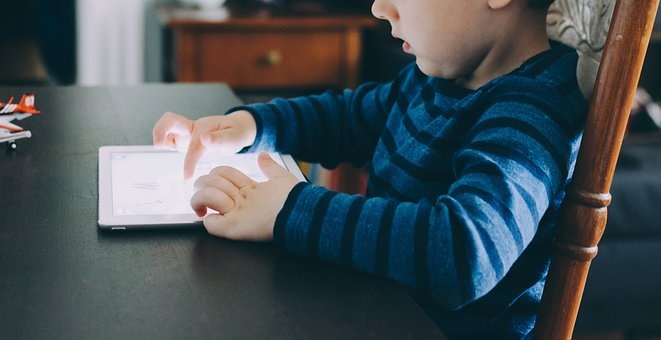
Most parents want their children to be tech savvy, to help them to cope in the real world that they will encounter once they leave school. A survey of 1,000 British mothers of 2 to 12 year olds conducted in 2015 found that 85% admitted to using screens to keep the children occupied so that they could get on with other activities.
So, apart from it being sad that yet another way of disconnecting from one another exists, why is all this screen time a bad thing? Surely something with so much educational potential should be all good?
The truth is that we don’t yet know the full impact that screen time has on young minds. The effect on bodies we can see, and it seems like they are getting bigger, less fit and more prone to disease, from colds and flu to cancer, diabetes and heart problems. With the average child spending double the time in front of a screen to the time spent playing outdoors, there is a real cause for health concerns.
It would also seem that using the internet, or rather screens whatever they are used for, also has a correlating effect on the intellect. I am no fan of exams (and there lies a whole other article) but for sixteen year olds who had been exposed to just one extra hour per day of screen time the results were falling grades in an average of two subjects, two extra hours and the grades fell in four subjects. Cambridge University who conducted the study, found that the results stayed the same even if extra time was put into studying to compensate for the recreational screen time.
Taiwanese parents of under 18s are now obliged under law to monitor their children’s screen time to ensure their children do not spend excessive time glued to a device. The French government has gone so far as to ban any television programmes aimed at under twos. One clinical psychologist, Catherine Steiner-Adair, author of the book The Big Disconnect: Protecting Childhood and Family Relationships In The Digital Age has studied the impact of digital technology upon the infant brain and its development and she concludes that ‘a baby’s brain is hardwired to learn language, and emotions and how to regulate them. There is no productive role technology can play in the life of a baby under two years.’
There are currently no official guidelines at all in the UK but the figures are worrying when the potential emotional, psychological and developmental impact is considered. Our little ones are very vulnerable, but so too are our teens. They may feel that they are able, via the web, to connect with people all around the world. ‘people who are on my wavelength, who like the same celebs, music, fashion or You Tubers as I do’ as one teen recently explained, but do these so-called connections serve the same needs as real, face-to-face interactions with peers, friends and family? Is the giant wave of emotional issues, so huge that local resources in most areas of the country are at full stretch or unable to cope, a result of working parents, poor education, poor diet or an over-simplified, over-reactive audience online?
Another issue is addiction. Dopamine is a chemical released in the brain, also known as the pleasure chemical. It is central to addictions from sugar to cocaine. One director of neuroscience calls screens ‘electronic cocaine’ and researchers in China have dubbed them ‘digital heroin’. Dopamine is produced when our brains are exposed to something new and interesting but it is also a reward chemical: something that our brains produce to make us feel good or happy with ourselves. We feel great when our brains release dopamine, to such an extent that some people will take enormous risks for their next dopamine hit; that is addiction. There are deep concerns among neuroscientists that if dopamine is produced every day, for several hours a day through, for example, playing a computer game or online messaging, for many years, that this could change the reward circuitry in the brain to make digital dependency a reality no less dangerous, life-altering and happiness-compromising than substance dependency.
So how much is too much? Google it; the advice is there for everyone with a screen to read, but please base your decisions on your own instinct as a parent. Yes, it is lovely to have the resource of the internet to answer the unanswerable questions, support learning when a parent feels shaky on a subject themselves, or even for an hour’s diversion on a long journey, but it is not without dangers and risks.

“We limit screen time to the time it takes me to cook tea’ explains Elaine, home educating mum of four. ‘At that end of the day I am too tired to care for the children effectively as well as cook something nutritious that we will all enjoy. An hour’s TV is the solution for us, and I don’t let it worry me.’
‘I don’t allow any screen time that has not been selected in advance by me for its educational purposes’ says David, home educating dad to Leon age 8. ‘Yes, it takes time and dedication to find age, ability and content appropriate material but I feel it is worth it. That way too we only watch things together and we can interact throughout and it limits the isolating factor of screen time and reduces the chemical effect on the brain considerably.’
A veteran home educator has the last word: ‘My older children used to watch TV while I cared for the little ones and got us all up, dressed, breakfasted and ready for the day. I have learned more recently about the dangers of this and they have given up all but half an hour first thing in the morning while I get organised. I find that they are more willing to help me now, more eager to engage with the day and interested in what we have planned. They also wash, dress and eat more efficiently and with greater enjoyment. They seem more conscious of life and that can only be a good thing.’
© Melanie Crocker-Hulse