SUBSCRIBERS’ HOME / FEATURES / NEW TO HOME EDUCATION? / PRACTICAL MATTERS / WEBSITES / RESOURCES / SEN / PLACES TO VISIT / SOCIAL LIFE / USEFUL INFORMATION / TUITION AND SERVICES / FROM YOU TO US
Planning and recording: Ceri’s flexible approach
My daughters are aged nine and seven and they have been educated at home for a year. I wanted to have some evidence to show the local authority person and I also wanted to make sure that we were well organised. I decided to plan simply by thinking about the girls’ education under the headings with which I’m already familiar through my work as a qualified Nursery Nurse:
- Personal, social and emotional development (this is mostly practical, so there’s not much written work under this heading);
- Communication, language and literacy;
- Mathematical development;
- Knowledge and understanding of the world (this includes science, history, geography, local knowledge and so on);
- Physical development (I just ensure that they get out and about a reasonable amount each week);
- Creative development (this is largely self-initiated).
Although the girls are much older than the preschoolers with whom I used to work, I find that the headings are useful in making sure that they have a broad range of things to do. I find that it helps to bear these areas in mind as we go on. The work is also filed under these headings to keep it in order in case we need to discuss it with the local authority at some point.
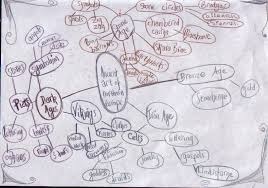
Every three or four months we put together a big spidergram of ideas for the future. We include any local festivities, events and activities plus any current interests that the girls have. It’s useful to have a source of ideas so that we don’t ‘dry up’. The spidergram can be pinned up, changed, crossed out, added to or forgotten about if we wish. We keep these big messy diagrams as evidence of our forethought and flexibility!
On Sundays we make a weekly plan which is stuck on the kitchen cupboard. Some arrangements and regular weekly activities are put in straight away, and I make a note of other things at the top which we do when it’s convenient. Some things are recorded after we’ve done them. We keep these sheets as they can be a source of inspiration to help us think of new ideas to explore.
Rose’s method
When my children were five and seven years old, and until about a year ago, I did very little formal work with them, although both learned to read and write very early on. I was confident that, whatever we did, they were well ahead of their peers at school. However, about a year ago I began to take maths more seriously. I ordered some Key Stage 2 Maths books from CGP and found that we were not as far ahead as I’d thought.
We have an active social life but, on as many mornings as possible I ask the children to do a page of a Maths book and an activity involving writing. I usually  sit with them and use it as an opportunity to identify any problems. Then we use our own examples to help their understanding, together with practical work. I used to make up my own exercises but it took me ages to do so, and it is so relaxing to use the workbooks.
We intersperse CGP with Schofield & Sims workbooks for English, maths and Science. CGP are fun and Schofield & Sims give a very good grounding in these subjects.
I used to tell everyone that it is easy to home educate. To some extent that is true and there are certainly many benefits. But it is time-consuming as I put a lot of thought and effort into what I do with the children although, to them, much of it may seem like play. I find that I spend a lot of time gathering material for activities and getting the children to and from various clubs.
I think that most of the parents whom I know have chosen home education because they want a relaxed lifestyle for their children. Although I want my children to avoid the pressures of school life as well, I would also like them to receive a better and more satisfying education than I did. The workbooks are a small part of our day but they are reassuring. I can relax in the knowledge that whatever we do the girls will have.
Deborah’s thoughts on social life
After sixteen years of home education my advice to anyone who is new to the experience is to get to know other home educators. The advice and friendship which they can offer gives confidence and support and at first it does feel as if you are striking out on your own. I was fortunate in having the support of my husband and family who have always been helpful. They have listened to me when I voiced doubts about what I was doing, and they have taken my son out for the day, regularly, to give me some time to myself.
By opting out of infant and junior school life parents, as well as children, need to find other ways of making friends and contacts. Fortunately, though, it is possible to have a social life without school! Meeting and socialising with other home educators can be one of the best things that you can do for yourself and your children.
Talking through experiences and problems with like-minded, sympathetic people is beneficial to all concerned. If possible, sharing responsibilities with other parents in specialist areas like music or maths spreads the load and makes learning more sociable. Once you make contact with other families in your area there may be opportunities to join in with activities which have already been set up including swimming lessons, sports coaching and many other group events.
There are lots of ways to make contact even if, like me, you are basically shy and 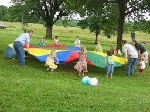 insecure about meeting new people. If you can attend some events it may be a good opportunity for informal introductions. Local meetings give new home educators a chance to meet others and it is useful to be able to compare notes and exchange ideas. The first contact often leads to attendance at other events or to new friendships. Often future events are discussed when families get together and you can have some input about what you would like the group to do in future.
Personally I have always been surprised by the variety of people who educate their children at home. If you should find that the first contacts are not very productive, don’t give up! It is worth trying to meet as many people as possible, and you could always arrange a meeting yourself. Forming friendships with other home educating families often provides good social opportunities for children and parents alike.
If there are no local activities in your area you may like to consider starting a group. Once there is a nucleus of two or three families who are willing to meet together it is an easy step to extend the group by contacting others and arranging activities. A thriving local group often grows from small beginnings.
Many possibilities emerge from contacts which are tentative at first. My son and I only knew of one home educating family at the other end of the county when we began, but we have built up a network of contacts in our own area, within the county and beyond. We have had many memorable days out in the town and countryside, at museums, theatres, parks, woods, castles and private homes. We have made lasting friends and valuable contacts. I have been able to help and advise other parents and I have grown greatly in confidence through my links with like-minded, dedicated home educators.